The science behind the glow

Why Does the La Parguera Bio Bay Glow?

The effect looks magical, but the mechanism is biology: microscopic organisms producing real light when the water around them is disturbed.

Updated September 2026 · Based on NOAA and Puerto Rico Bio Bay guidance

Living lightThe organisms create their own light.
DinoflagellatesMicroscopic plankton produce the flashes.
Motion triggers flashesWake and splashes reveal the effect.
Usually blue-greenThat color travels well through seawater.

The simple explanation

The water is not glowing. Living organisms in the water are producing light.

La Parguera’s famous effect comes from microscopic single-celled organisms called dinoflagellates. When conditions allow enough of them to concentrate in the bay, a disturbance in the water can trigger countless tiny flashes at once.

That is why the effect follows motion. A boat wake can become a streak. A hand moving through the water can create sparks. A fish can leave a brief glowing path. The light is biological, not electrical.

Bioluminescence ≠ fluorescence.

The organisms are generating light through a chemical reaction. They do not need an outside light source to “activate” the glow.
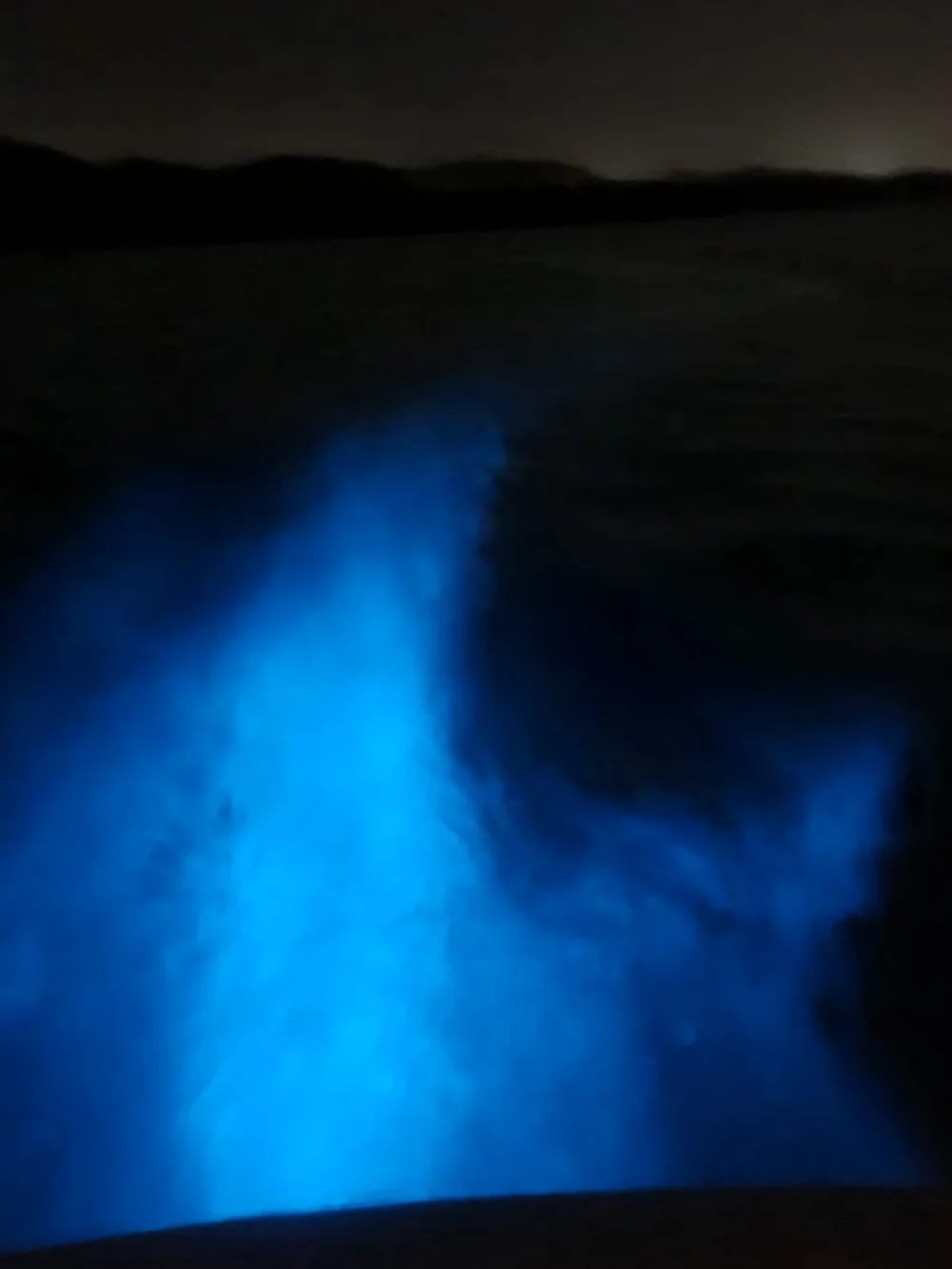
Subtle real-world bioluminescent water photographed by Captain Luis
Captain Luis’s real-life reference. The effect is most obvious in disturbed water, not as a uniformly illuminated blue surface.

The organisms

Dinoflagellates are tiny—but millions of flashes can become visible.

Puerto Rico’s tourism guidance identifies Pyrodinium bahamense as the dinoflagellate associated with its Bio Bays. Each organism is microscopic, but a high concentration turns individual flashes into something your eyes can see across moving water.

The same basic idea appears in NOAA’s bioluminescence science: living organisms create visible light through chemical reactions, and marine bioluminescence commonly appears blue or blue-green.

The chemistry

Living light is a chemical reaction.

01

Biological system

The organism contains the chemical machinery needed to produce light.

02

Trigger

In bioluminescent dinoflagellates, disturbance can trigger a very fast flash.

03

Visible result

Many simultaneous flashes create the sparkling blue-green effect people recognize as a Bio Bay.

NOAA describes bioluminescence as light produced by an organism through a chemical reaction.

Why motion matters

The wake is often more dramatic than still water.

A completely calm patch of water can look almost ordinary in the dark. Once something moves through it, the mechanical disturbance triggers flashes, revealing the concentration of organisms.

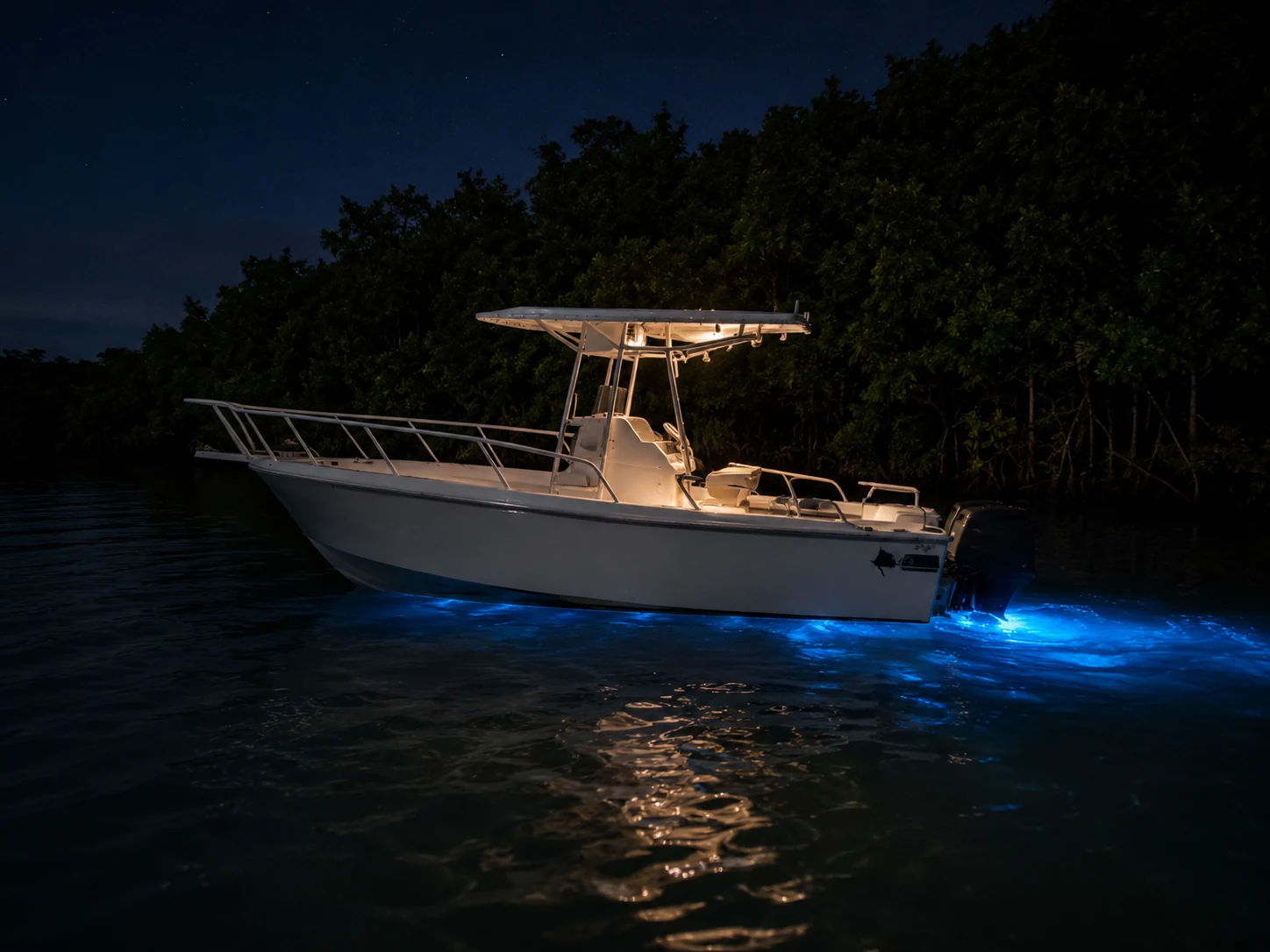
This is why realistic Bio Bay photography often shows glow close to a hull, paddle, swimmer, or wake rather than an entire horizon of neon-blue water.

Captain Luis style boat creating a subtle bioluminescent wake
The glow tracks disturbance. The active water around the hull and wake is where the effect becomes easiest to read.

Why Bio Bays can exist

The geography helps keep the organisms concentrated.

Protected water

Shallow, sheltered water can support the conditions needed for high concentrations.

Restricted exchange

Narrower entrances can help keep organisms from dispersing as quickly into open water.

Tidal renewal

Tidal water continues to move through the system rather than leaving it completely stagnant.

Healthy coastal habitat

La Parguera sits inside a broader reserve of mangroves, seagrass, reefs, bays, and salt marshes.

Protecting the experience

Darkness helps visitors—and responsible behavior helps the ecosystem.

Puerto Rico tourism guidance recommends reducing unnecessary artificial light and following conservation rules. For visitors, that improves dark adaptation. For the site itself, responsible operation matters because this attraction exists only as long as the natural system stays healthy.

  • Keep phone screens and flashlights low when possible.
  • Follow the captain’s safety and conservation instructions.
  • Do not remove organisms, plants, or wildlife.
  • Avoid treating the bay like an amusement-park effect that should perform on command.

Common questions

Quick answers before you plan.

These answers are meant to set realistic expectations and help you choose the right experience.

What causes La Parguera’s water to glow?

Microscopic dinoflagellates in the water produce bioluminescent light through a chemical reaction. In La Parguera, the glow is associated with Pyrodinium bahamense.

Why does movement make the water light up?

Mechanical disturbance can trigger a brief flash in bioluminescent dinoflagellates. That is why wakes, splashes, paddles, hands, and fish movement can create visible trails or sparks.

Is the blue glow caused by a flashlight or ultraviolet light?

No. Bioluminescence is light produced by the organism itself. External light is not required and bright light can make the natural flashes harder to see.

Why is marine bioluminescence often blue or blue-green?

NOAA notes that blue light travels efficiently through seawater, and much marine bioluminescence is blue to blue-green.

Are the organisms dangerous?

Discover Puerto Rico identifies the Pyrodinium bahamense associated with Puerto Rico’s Bio Bays as non-toxic. Visitors should still follow all current operator and conservation guidance.

Sources

Sources & further reading

This page is based on current Puerto Rico tourism guidance, NOAA science, Puerto Rico environmental information, and the services actually offered by Captain Luis. Natural conditions can change, so no page should be treated as a brightness or weather guarantee.

Plan your La Parguera experience

See the science in motion instead of just reading about it.

Choose a private evening and watch the water react around the boat in real time.

Check Bio Bay availability